Day 1: Arrive in Kathmandu
Altitude: 1,400 m / 4,593 ft
Upon arrival at Tribhuvan International Airport, you will be met and assisted by one of our representatives.
After collecting your baggage, follow the path outside the airport where our local guides will be waiting in the arrivals section.
Upon arrival in Kathmandu, transfer to the hotel.
After some refreshments, transfer to Boudhanath.
Built on a massive three level mandala, the Boudhanath Stupa is one of the largest in the world and a UNESCO World Heritage Site. It is on the ancient trade route from Tibet that enters the Kathmandu Valley. Tibetan merchants have rested and offered prayers here for many centuries. A popular tourist attraction, there are many shops around the stupa selling souvenirs, handicrafts, and a variety of exclusive Tibetan specialties and delicacies.
Light butter lamps as an offering of light to the deities. Lighting butter lamps is considered one of the most common means of making merits and one of the most powerful offerings. The light from the flame symbolizes the wisdom of the awakened mind, dispels the darkness of delusion and mental obscuration.
Enjoy a sundowner at a rooftop restaurant in Boudhanath, while you are served refreshments – tea/coffee and snacks.
Overnight at Traditional Homes Swotha, Patan
Day 2: In Kathmandu
Altitude: 1,400 m / 4,600 ft
After breakfast, visit to Kathmandu Durbar Square following Swoyambhunath.
Like any big city, Kathmandu has seen rapid expansion in the last decade, but despite the hustle and bustle so typical of metropolitan cities, its people remain as refreshingly friendly as ever. Retaining its ancient traditions, Kathmandu is blessed by a Living Goddess and is enriched by endless ceremonial processions and events that take to the streets every now and then with throngs of devotees seeking blessings. These religious festivals are steeped in legend and are quite a spectacle with chariot processions and masked dancers often possessed by the spirits of deities.
Take an exciting rickshaw (tricycle) ride honking your way through narrow alleys to the bustling bazaars of Ason. Sit back and relax as you navigate for a slightly different experience of exploring the city like a local.
Later, visit Swoyambhunath Stupa, a UNESCO World Heritage Site. It rests on a hillock and is one of the most important and sacred Buddhist shrines of Nepal. Legend has it that when Kathmandu Valley was a lake 2000 years ago, a single lotus flower grew at the center of the lake. When Saint Manjushree, the Boddhisatva drained the lake with a single slash of his sword, the lotus settled on top of a hill and magically turned into a stupa. Thus, Swoyambhunath is also known as a Self-Created stupa.
After the visit, transfer to Patan.
For lunch, learn the art of Nepalese culinary at a local restaurant or for a more authentic experience, visit a local home and later savor the relish. The chef / family member will demonstrate the cooking procedures, and you will have a chance to see, learn & taste the local Nepali cuisine. Full of fun and flavors, this lesson will last for about an hour or two.
Patan, also known as Lalitpur, the city of artisans, is a paradise of fine arts and best known for its rich cultural heritage. It is home to the valley’s finest craftsmen who have preserved such ancient techniques as the repoussé and lost wax process used to produce exquisite sculptures. The city retains much of its old charm with its narrow streets, brick houses and multitude of well-preserved Hindu temples, Buddhist monasteries (vihars) and monuments.
In the heart of Patan, amidst the Patan marketplace lays the Patan Durbar Square, an area filled with ancient palaces, pagoda temples, stone baths, Hindu and Buddhist statues, engravings and bronze cravings. The Palace of the Malla Kings is one of the highlights of Patan. Patan Durbar Square is also a UNESCO World Heritage Site.
Nepal is blessed by a Living Goddess, Kumari. It is a tradition of worshiping young pre-pubescent girls as manifestations of the divine female energy or Devi in Hindu religious traditions. Dressed in festive red, glittering jewel accessories, long and heavy eye makeup and a striking third eye on the brow, the Kumari is a live representation of the Hindu goddess Durga. She is an iconic symbol and a living embodiment of the harmonious mixture of Buddhism and Hinduism.
Visit the current Kumari in her chambers in Patan and get her blessings as she sits upon a gilded lion throne. The power of the Kumari is perceived to be so strong that even a glimpse of her is believed to bring good fortune.
Transfer back to the hotel.
Overnight at Traditional Homes Swotha, Patan
Day 3: Fly to Lukla by private or shared helicopter. Trek to Monjo
Trek duration: 5 hours approx.
Altitude – Lukla: 2,856 m/ 9,370 ft.
Altitude – Monjo: 2,835 m/ 9,300 ft.
Today, fly from Kathmandu to Lukla (2,860 m) by helicopter. After a scenic flight above the spectacular mountains, arrive at one of the most beautiful air routes in the world culminating in a dramatic landing.
Upon arrival at Lukla, meet our other crew members and after some packing and arrangements, trek through the village of Lukla until reaching Monjo for overnight stay.
Overnight at Simple Lodge
Day 4: Trek to Namche
Trek Time: 4 hours approx.
Altitude: 3,446 m / 11,300 ft
Continue your trek northward up the Dudh Kosi valley to Jorsale, where you’ll officially enter Sagarmatha National Park. At the entrance station just beyond the village, your trekking permits will be checked, and national park fees collected.
The trail then leads you across the Bhote Kosi River, setting the stage for a steep climb up to Namche Bazaar. As the administrative center of Sagarmatha National Park and the heart of Sherpa society, Namche Bazaar offers a unique cultural experience. Along the way, keep an eye out for glimpses of Mt. Everest, a thrilling preview of what’s to come.
Overnight at Simple Lodge
Day 5: Trek to Tashinga
Trek Time: 3 hours approx.
Altitude: 3,450m / 11,320 ft
After breakfast, continue your trek to Tashinga. Along the way, you’ll pass trains of yaks, dzos, and porters.
The afternoon is yours to enjoy at leisure. If you’re feeling well-acclimated to the altitude, you might consider exploring the area or taking a short hike nearby. For those who prefer a slower pace, this is the perfect time to relax and allow your body to adjust to the altitude.
Overnight at Simple Lodge
Day 6: Trek to Pangboche
Trek Time: 6 hours approx.
Altitude: 3,985 m/ 13,075ft.
This morning, looking across the valley, you can see the path sloping diagonally up towards the famous monastery of Tengboche, but first you must descend to the river. This takes about an hour, descending steeply in a series of zigzags to the Dudh Kosi River. From the river, it takes approximately 2-3 hours to reach the monastery at a slow, even pace.
The ascent begins with a steep climb through a shaded pine forest before emerging onto a long, gentle path that rises like a ramp toward your monastery. Emerging at the top, there is a mandala gateway and a huge chorten, which are passed before your first sight of the gompa. The setting is nothing short of magic and it is incredible to think that the temple was burnt down only a few years ago and was re-built largely through the efforts of the Sir Edmund Hillary Trust.
Overnight at Simple Lodge
Day 7: Day Hike to Ama Dablam Basecamp. Back to Pangboche
Altitude: Ama Dablam Base Camp – 4,575 m / 15,000 ft
Trek duration: approx. 6 hours
This morning, you will head for an excursion to Ama Dablam base camp. For this walk you begin by crossing the Imja river on a suspension bridge, followed a gradual ascent until Lhabarma where you will find yourself standing right in front of the mountain ridge. From here you have an incredible view of Ama Dablam (6856m), Kantega (6783m), Nuptse ridge (7879m), Lobuche peak (6090m), Pumori (7165m), Thamserku (6623m), Kangtega (6783m), Cholatse (6335m), Taboche peak (6495m), Khumbi La (5765m), Kwangde Ri (6011m) and the beautiful mimbo glacier.
Ama Dablam base camp is located at an altitude of 4,575m on an open yak pasture beneath the west face of the mountain. The climbing route, southwest ridge and the hanging glacier, the treasure box of Ama Dablam sits almost straight above.
Overnight at Simple Lodge
Day 8: Overfly EBC and Kalapathar and Back to Kathmandu
Altitude: 5,160 m / 16, 942 ft
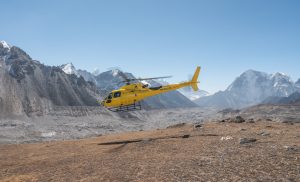
Begin the day with an early morning helicopter ride—a scenic journey that offers an incredible aerial perspective of the Khumbu region. Lifting off from Pangboche, the helicopter flies up the valleys, offering unobstructed views of the dramatic Himalayan landscape.
You will overfly Everest Base Camp and Kala Patthar, capturing once-in-a-lifetime views of Mount Everest, Lhotse, Nuptse, Pumori, and the stunning Khumbu Glacier. A brief landing will be made at a selected viewpoint, conditions permitting, allowing you to step out, take photographs, and absorb the majesty of the world’s highest peaks.
After the scenic aerial experience, continue your flight back through the mountains to Lukla and onward to Kathmandu, where you will have the rest of the day at leisure to relax.
You will now drive to Dhulikhel, which has always been an important trade center, is a place of exhilarating beauty and unparalleled serenity. Also popular for the remarkable view of the sunrise and sunset, Dhulikhel is famous for its vantage location in viewing the Himalayas. The old town of Dhulikhel is a close traditional Newari settlement with an assembly of fine old Newari houses with beautifully carved windows and doors. The core area of Dhulikhel has interesting narrow cobbled streets and lanes embedded with number of Hindu Shrines and a few Buddhist Stupas.
Upon arrival, check in to the hotel, where the remaining day will be at leisure.
Overnight at Visuddhi Alaya
Day 9: Wellness Day at Vishuddhi Alaya
This day is dedicated to rest, renewal, and mindful practices.
The day is free to enjoy the wellness facilities and activities offered at Vishuddhi Alaya. Guests may join guided walks through nearby villages and forest trails or take part in seasonal organic gardening. The resort also offers a sauna, a Japanese-style ofuro bath, and a selection of Ayurvedic massages and facials.
A glass-covered yoga and seminar hall is available for yoga, meditation, or quiet time.
Optional Hike: Namo Buddha
Easy, approximately 3.5 hours, mostly uphill Namo Buddha Hike
Grade: Easy – uphill
Trek Duration: approx. 3.5 hours walking.
Located on a slightly elevated land, glistened with distant snowcapped mountains, adorned with fluttering prayer flags Namo Buddha is a sanctuary of peace and harmony.
For centuries Namo Buddha has drawn pilgrims to the sacred spot where legend has it that the Great Being, an early incarnation of Lord Buddha while on a walk through the dense forest came across a starving tigress and her five cubs. The tigress was so weak that she was unable to feed herself or her cubs. The Great Being was tormented at the sight of a mother unable to feed her children. Hence, out of sheer generosity, the Great Being sacrificed his own flesh to feed the starving tigress and her cubs.
The ancient stupa of Namo Buddha is where the remains of the Great Being after his sacrifice are buried. Today, this site has become a special place to accumulate merit through activities of circumambulation and making offerings. People from all over the world visit the site to pay homage to the Great Bring and make traditional offerings of butter lamps. A carved stone slab depicts this Buddhist tale of selfless compassion and sacrifice.
After Great Being offered his body in generosity to the tigress, people found it difficult to travel through the region for fear of wild animals, so they developed the practice of reciting ‘Namo Buddha’ (I take refuge in the Buddha) to dispel their anxiety. This is how the area gets its name. As time passed, villages gradually appeared and the area became more urban and less dangerous.
Overnight at Vishuddhi Alaya
Day 10: Final departure
After breakfast, transfer to the International airport in time to board the outbound flight.